ITER successfully tests massive 330-ton superconducting magnet
The ITER international thermonuclear reactor has successfully tested a massive 330-ton superconducting coil at −269 °C and 34 kA current.
·2 min read
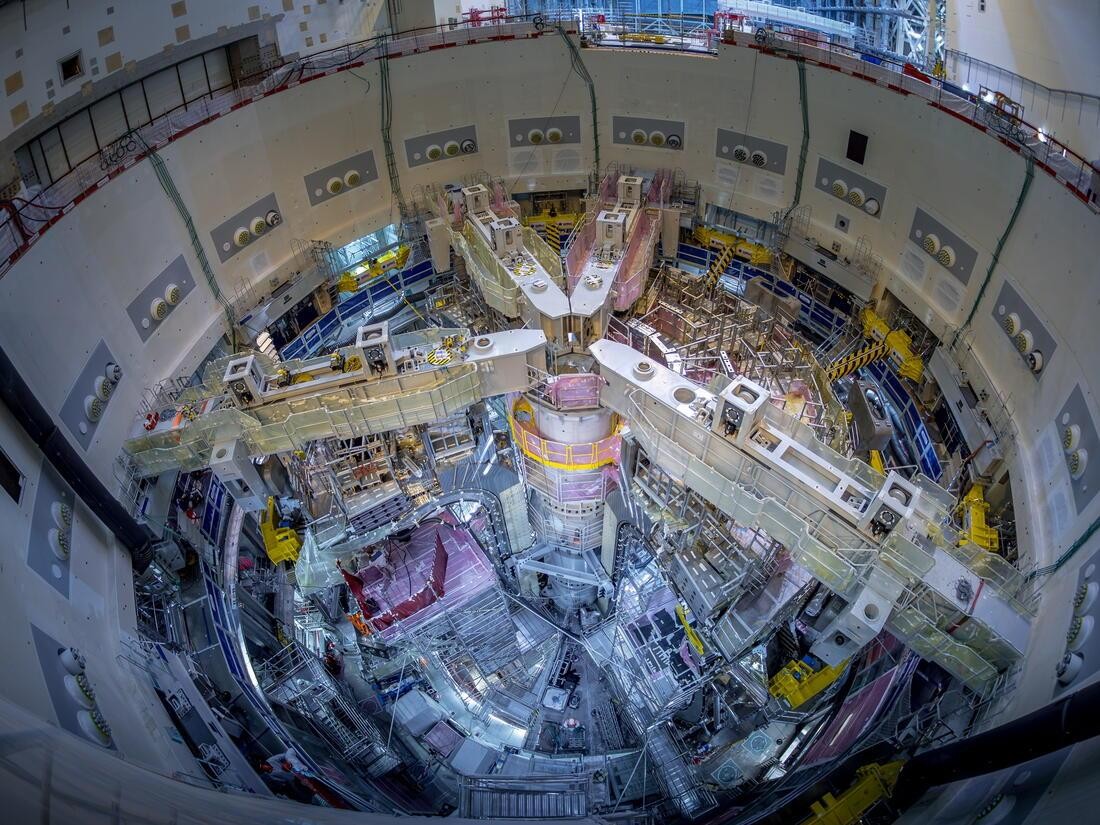
The ITER international thermonuclear experimental reactor has reached a major milestone in testing its vast magnetic system. Engineers successfully completed tests on one of the facility's largest superconducting coils, weighing 330 tons. This accomplishment brings the ambitious artificial sun project closer to its ultimate assembly and operation.
- The ITER magnetic system relies on 18 toroidal field coils, poloidal magnets, and a central solenoid.
- Coil #17 was cooled down to −269 °C and tested with a 34 kA electrical current.
- Engineers confirmed that the magnet's physical deformation under electromagnetic forces matches precise computer models.
Successful Testing of Magnet Coil #17 Testing of the D-shaped toroidal field coil #17 began in August, marking the largest scale evaluation in terms of test current since the program's inception. The 330-ton component was cooled to 4 Kelvin, equivalent to −269 degrees Celsius, before a current of 34 kA was passed through it. This represented exactly half of its nominal operating value of 68 kA. Engineers confirmed that the structural deformation under immense electromagnetic forces behaved precisely as predicted by theoretical models. Following the successful completion of these low-temperature evaluations, the coil was extracted from the test facility on October 30. It was placed on a transport frame and will temporarily be stored before being transferred to the ITER assembly hall for integration into the reactor's vacuum vessel.
Testing Schedule and Future Engineering Plans The superconducting magnet testing program kicked off in May 2026 with coil #7, which was tested at 10 kA to check electrical joint resistance and quench detection systems. The tests on coil #17 allowed researchers to advance to significantly higher loads and evaluate structural integrity under increased stress. The next component to undergo evaluation will be spare toroidal coil #19, with cooldown procedures scheduled to begin in April 2027. In addition to standard current loads, engineers plan to test the thermal margin of the coils by intentionally heating specific sections to induce a loss of superconductivity, thereby validating safety mechanisms. Once all toroidal magnets are fully tested, the facility will be reconfigured to evaluate the first poloidal field coil. Together, these systems will generate powerful magnetic fields to confine superheated plasma.
The Global Scope of the ITER Project Located in southern France, ITER is a massive international scientific collaboration involving 35 nations, including the European Union, the United States, Russia, China, India, Japan, and South Korea. Its primary objective is to demonstrate the scientific and technological feasibility of controlled nuclear fusion. By merging hydrogen isotopes like deuterium and tritium inside a magnetic cage, the reactor aims to replicate the energy-producing mechanisms of the Sun and stars. While ITER is not designed to produce commercial electricity, its goal is to demonstrate the production of ten times more fusion power than the energy injected to heat the plasma. Operating temperatures inside the vessel are projected to reach approximately 150 million degrees Celsius, requiring advanced magnetic confinement systems.
What This Means for Future Energy Technologies The successful testing of such unprecedented superconducting hardware represents a crucial stepping stone toward the development of future commercial fusion power plants. As global energy demands grow, breakthroughs in cryogenic engineering, materials science, and magnetic confinement pave the way for a cleaner and virtually limitless power source. The empirical data gathered by ITER engineers helps de-risk the upcoming assembly phases and validates global investments in clean energy research.
Source: iXBT.com