Weight-space programming: a new way to improve AI without retraining
Researchers have proposed weight-space programming to improve AI models by editing their weights without traditional retraining.

Researchers at MIT's Computer Science and Artificial Intelligence Laboratory (CSAIL) have proposed a novel approach to improving AI model efficiency called weight-space programming. This method allows for enhancing neural networks by directly editing their numerical parameters without the need for traditional retraining, potentially speeding up development.
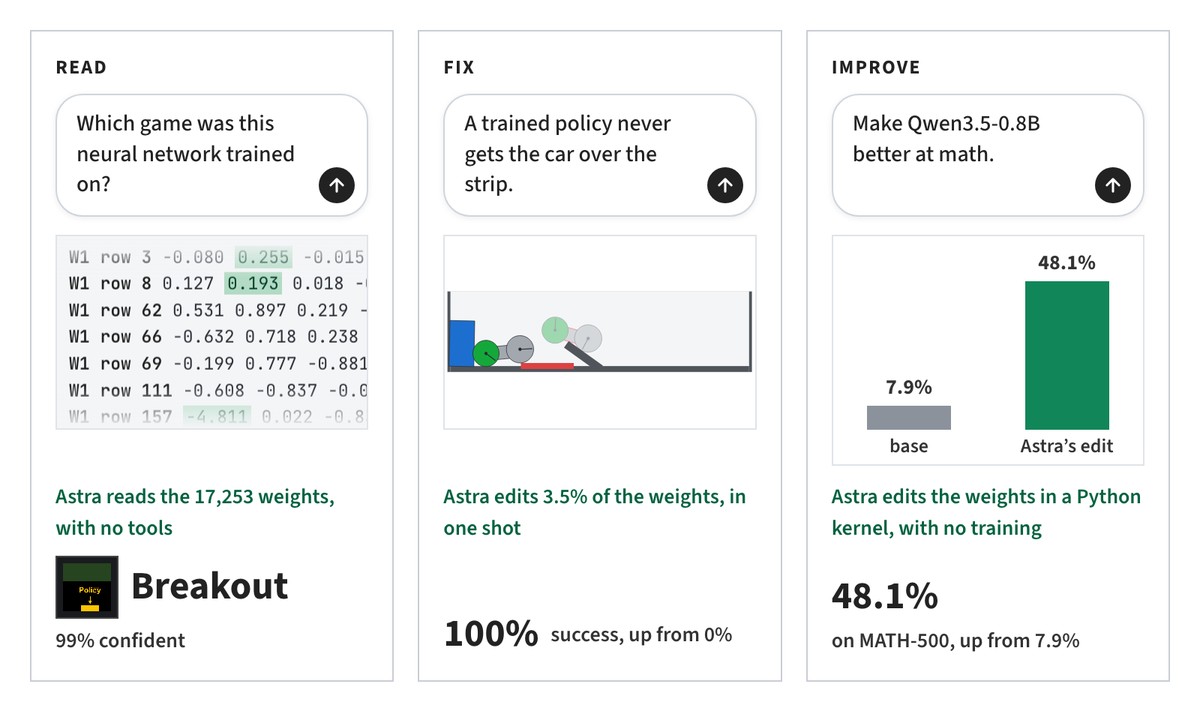
- Researchers used OpenAI's GPT-6 Astra model to edit the weights of the open-source Qwen3.5-0.8B model.
- The MATH-500 benchmark score jumped from 7.9% to 48.1% by modifying just 0.016% of total weights.
- Success was achieved primarily by eliminating repetitive logical reasoning steps.
- AI researcher Yuchen Jin described the technology as genetic engineering for neural networks.
Experiments and capabilities
During the experiments, the AI model analyzed the target neural network, studied its behavior, and independently determined which weights to modify without using standard gradient-based training. Researcher Yuchen Jin noted that this approach is even cooler than distillation, opening up new horizons for model optimization.
If researchers can make this method reliable enough, developers will gain a tool to quickly adjust neural networks and boost performance without conventional training overhead. Target weight editing could potentially reduce time and compute resources, though the exact savings are yet to be established as the method remains experimental.
Read alsoGPT-6 Astra and MIT CSAIL: Direct Weight Editing in Neural NetworksLimitations and community concerns
The new approach is not universal. For instance, in an experiment with the Gemma 3 270M model, which did not exhibit severe repetition issues, Astra's edits did not improve math capabilities. Another experiment showed that without additional data, the model struggled to reliably distinguish between different behavior types.
Opinions within the AI community are divided. While some see it as a tool for rapid model maintenance and resource saving, others express fears that it could accelerate AI development dangerously close to uncontrolled risks. Maxime Fournes, CEO of Pause AI, warned that such reckless research directions could bring humanity closer to a global catastrophe.
Industry implications
The advancement of weight-space programming could fundamentally shift how developers optimize large language models. If proven stable and effective, companies could significantly lower the costs associated with training and updating massive AI architectures.
At the same time, ethical concerns and risks related to uncontrolled AI self-improvement remain prominent. Balancing technological progress with rigorous safety measures continues to be a crucial challenge for the global tech community.
Source: 3DNews: