What Is Next for Nvidia After Jensen Huang Step Down
Jensen Huang steps down after 33 years, leaving Nvidia at a crossroads. What does the future hold for the AI hardware giant?
Nvidia's board announced that Jensen Huang has resigned 33 years after co-founding the company, raising crucial questions about the future of innovation without its visionary leader. History shows that when visionary CEOs depart, companies often struggle to maintain their edge.
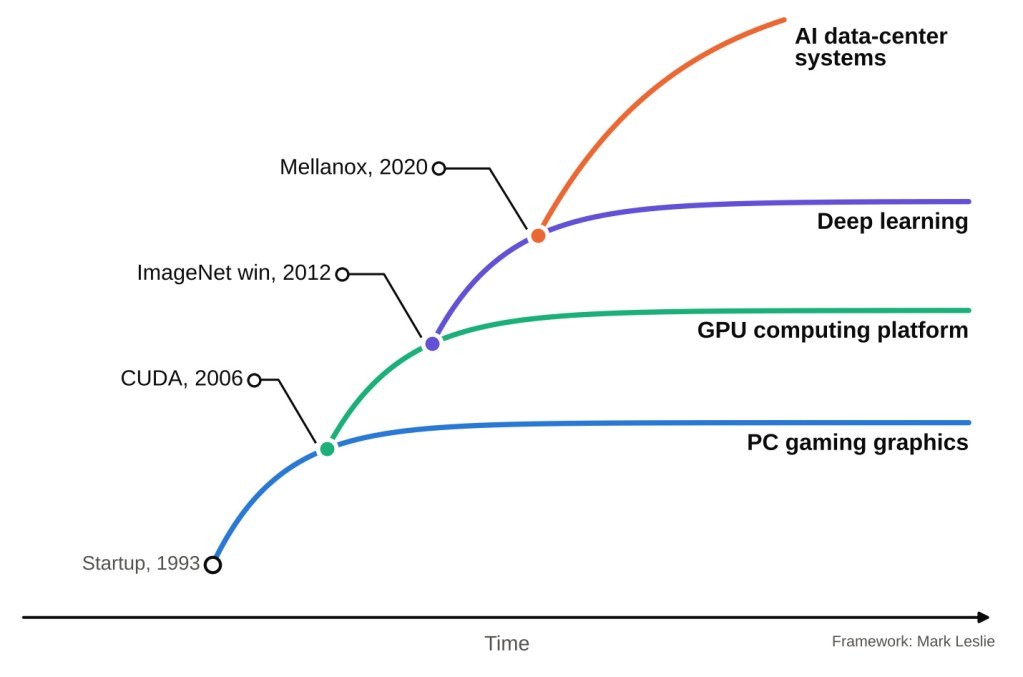
- Jensen Huang reinvented Nvidia three times: launching CUDA in 2006, pivoting to deep learning in 2012, and acquiring Mellanox for AI datacenters in 2020.
- Like Steve Jobs at Apple, Huang was a world-class innovator who deeply understood products and markets rather than leading by committee.
- Major customers like Google, Amazon, Microsoft, Meta, OpenAI, and Tesla are currently building their own proprietary AI chips.
A Legacy of Radical Business Reinvention
During his tenure, Jensen Huang successfully transformed Nvidia from a niche PC gaming graphics card vendor into the foundational hardware backbone of the artificial intelligence revolution. Funding CUDA years ahead of any revenue and shifting from selling individual boards to integrated datacenter racks demonstrated unprecedented strategic foresight.
These transformations required a leader who deeply understood product engineering and could foresee market shifts before anyone else. Visionary founders like Huang do not rely on traditional succession planning, making the transition period exceptionally challenging for a company structured around a single central decision-maker.
Read alsoNvidia CEO Jensen Huang faces board talks amid FBI spy investigationLessons from Microsoft and Apple
The history of tech giants illustrates the dangers of replacing a visionary founder with an execution-focused CEO. When Steve Ballmer took over Microsoft, he successfully increased sales and profits but completely missed critical technology shifts including search, smartphones, mobile operating systems, and cloud computing.
Microsoft was eventually saved when Satya Nadella took charge and pivoted the company toward cloud infrastructure. Similarly, while Tim Cook successfully grew Apple's revenues and hardware ecosystem over 15 years, the company lagged behind in artificial intelligence and struggled with major new hardware product categories.
The Road Ahead and Emerging Challenges
The immediate threat to Nvidia is organizational as the next CEO will inevitably need to introduce management layers to replace a leader who managed around 60 direct reports without one-on-ones. This structural shift risks altering the corporate culture and driving away creative talent.
Furthermore, Nvidia's largest clients are increasingly becoming competitors by developing their own AI chips. To maintain its market dominance, Nvidia must continue its aggressive pace of hardware and software innovation while defending its integrated ecosystem against well-funded rivals.
Source: Hacker News: Front Page