Windows 11 desktop rendering is now tested on NPU instead of GPU
Developers have created an experimental npu-driver for Windows 11 that offloads desktop and app rendering from the GPU to the NPU.
·2 min read
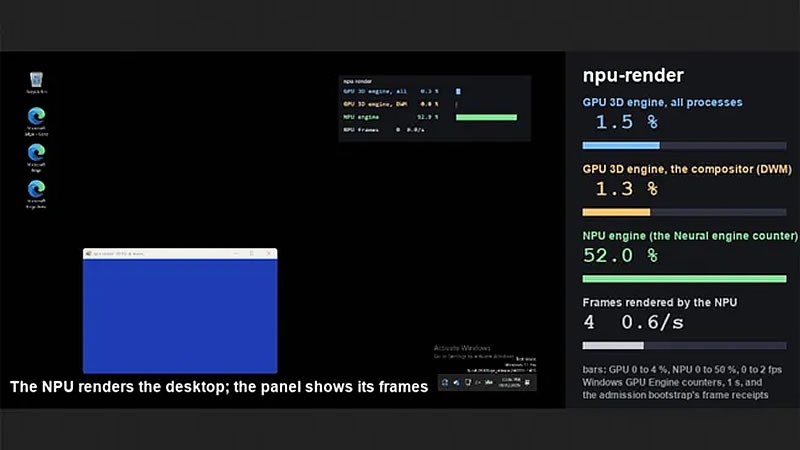
Developers from the Labscommunity group have introduced an unconventional experimental project designed to explore new use cases for modern neural processing units. They have developed an experimental driver called npu-driver, which allows Windows 11 to render the desktop and application windows using an NPU instead of a traditional GPU.
- Developers created the experimental npu-driver to render Windows 11 via NPU.
- The current refresh rate is 2–3 Hz, with a target to reach 30 Hz.
- GPU load during 3D graphics processing dropped from 3.4% to 0.6%.
- Tests are conducted on an Intel Panther Lake laptop with a 45–50 TOPS NPU.
How the Experimental NPU Driver Operates The newly introduced driver handles the visual output of not only the desktop environment but also application windows, including Notepad and the Microsoft Edge web browser. Crucially, the operating system and applications do not need to know which specific hardware component is performing the rendering work, ensuring seamless integration into the existing software stack. To prevent system instability, the driver includes a fallback mechanism. If an error occurs or upon a user request, the rendering process automatically switches back to the conventional GPU. This safety measure makes it feasible to test the early-stage prototype without risking permanent system crashes or critical failures during everyday tasks.
The Motivation Behind Offloading Graphics to NPU Labscommunity points out that modern laptops are increasingly equipped with powerful NPU chips that often remain idle while the GPU handles desktop composition, web browsing, and local AI workloads. Repurposing the neural processor for basic display tasks provides a way to balance system loads more efficiently across available silicon. Initial performance measurements demonstrated that shifting these tasks to the NPU reduced the GPU workload during 3D graphics processing from 3.4% down to 0.6%. This frees up valuable graphical processing resources for other intensive operations, including the execution of local AI models and machine learning tasks.
Current Limitations and Open Source Availability At this stage, the npu-driver is strictly an exploratory research prototype rather than a ready-to-use commercial product. The primary technical limitation right now is the low refresh rate of just 2 to 3 frames per second, though the developers have set a clear goal to optimize the code and increase this metric up to 30 Hz. For developers and hardware enthusiasts interested in exploring the technology, the source code has been published on GitHub under the permissive Apache 2.0 license. This allows anyone to study, modify, and utilize the software for various purposes, paving the way for further community-driven innovations in hardware utilization.
Source: 3DNews: