Foundry Robotics raises $100 million for autonomous factory
Foundry Robotics has secured $100 million in Series A funding to build the first fully autonomous complex electronics factory in the US.
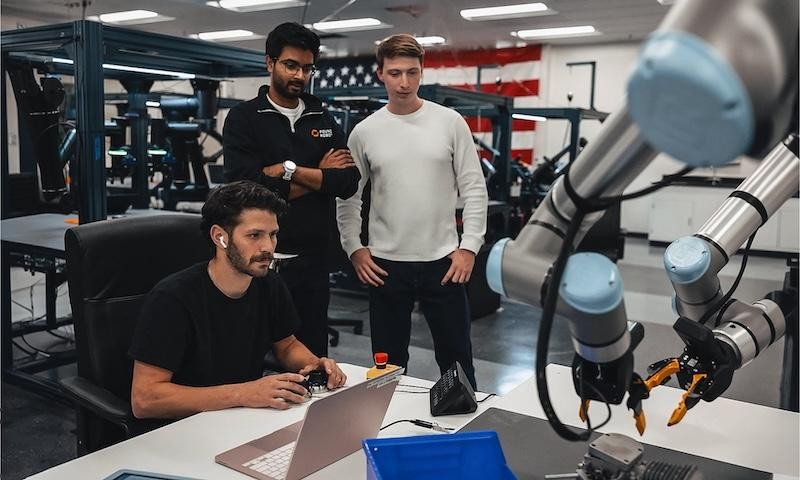
American startup Foundry Robotics has closed a $100 million Series A funding round to build the United States' first fully autonomous assembly factory for complex products. The funds will be used to expand a 130,000-square-foot (12,000-square-meter) facility—which is 20 times larger than the company's previous asset—and to accelerate the deployment of AI models into real manufacturing processes.
- Secured $100 million in Series A funding for autonomous manufacturing.
- New facility spans 130,000 square feet (12,000 square meters).
- Operates under a manufacturing-as-a-service model driven by FoundryOS.
- Clients include defense and commercial electronics and drone manufacturers.
Manufacturing-as-a-service and FoundryOS platform
Foundry builds, owns, and operates its own factories under a unique manufacturing-as-a-service model. Customers do not need to invest heavily in new assembly lines or expensive retooling, as the journey from initial design to final production takes only weeks. Inside the facility is a grid of robotic cells managed by the proprietary FoundryOS operating system.
The integrated artificial intelligence learns continuously from basic assembly operations. As a result, the exact same robotic cell can assemble a drone today and switch to manufacturing a satellite component tomorrow, becoming increasingly precise with every single production run.
Read alsoTesla makes FSD autopilot free through new referral programExperienced leadership team and facility expansion
The startup's leadership team brings together veterans from prominent technology companies such as Tesla and Ghost Robotics. Co-founder and CEO Adarsh Kulkarni previously led robotics at Scale AI, while co-founder Emmanuel Lamacchia managed the Model Y program at Tesla, overseeing the production of approximately 1.5 million vehicles per year.
With the new capital injection, Foundry will scale up into a facility that is twenty times larger than its previous operating footprint. This comprehensive approach allows the company to own the entire manufacturing pipeline rather than relying on fragmented automation.
Implications for hardware development and industry
Traditional assembly lines often delay the production of complex electromechanical products because deploying conventional lines can take many months. Flexible autonomous factories promise to radically shorten the path from blueprint to finished hardware, which is critical for aerospace, defense, and telecommunications.
By replacing human intervention with AI-driven robotics at every level, these advanced facilities aim to redefine hardware manufacturing speed and efficiency in the United States, providing a competitive edge for hardware startups and large enterprises alike.
Source: iXBT.com