ITMO University Researchers Create Perovskite Microlaser for Vortex Light
Russian physicists have developed a micro-scale perovskite laser that controls twisted vortex light for optical chips.
·2 min read
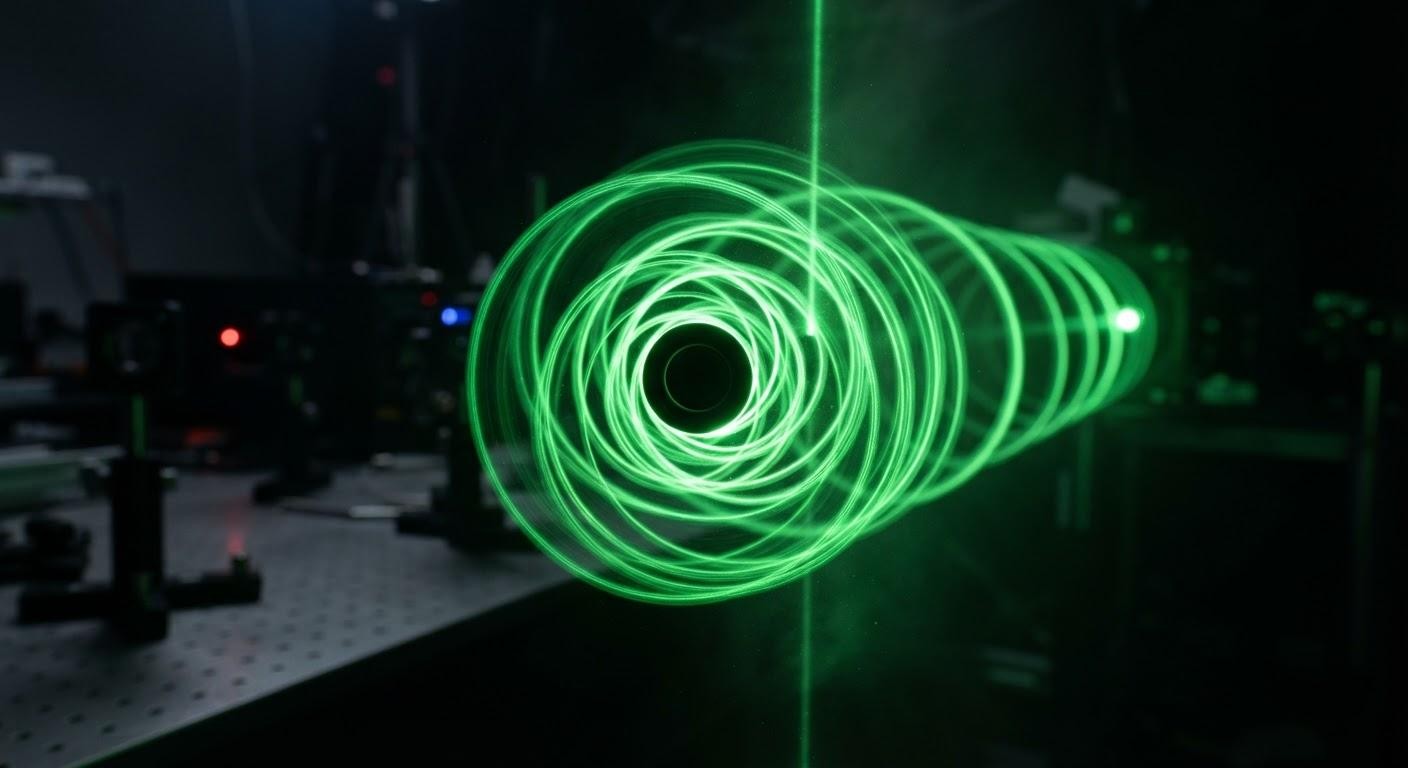
Researchers from ITMO University, in collaboration with the Institute of Automation and Control Processes of the FEB RAS, have introduced a breakthrough microphotonic device. The scientists have developed a compact perovskite-based microlaser capable of generating and controlling vortex light—radiation twisted around its own propagation axis.
- Developed a compact perovskite microlaser a few microns in size for photonic chips.
- Formed nano-holes resembling gear teeth along the edges of microdisks to control light.
- Created a material processing method using ultrashort high-power laser pulses.
- Enabled extracting vortex light beyond the photonic chip for quantum systems.
Properties of Vortex Light and Perovskite Materials Vortex light differs fundamentally from conventional laser radiation because its wavefront spirals around the axis of propagation. This unique property enables highly efficient data encoding for modern telecommunications, as well as advanced applications in sensor systems and quantum computing. However, practical implementation requires miniature sources of such light that can be seamlessly embedded directly into microchips. To address this challenge, the researchers utilized perovskites—semiconductor materials with a crystal structure resembling a natural mineral. Perovskites exhibit exceptional luminescence and are well-suited for precise technological processing, making them ideal candidates for advanced microscale lasers.
Innovative Design and Processing Technique To achieve precise control over the light, the physicists fabricated microdisks a few microns in diameter and modified their edges. They formed a series of nano-holes along the perimeter, arranged similarly to the teeth of a gear. This specific geometric arrangement allows fine-tuning of the emitted light characteristics and controls its rotation direction. To process the material without damaging its delicate structure, the team developed a method based on powerful ultrashort laser pulses. This technique allows arbitrary nano-hole patterns to be etched onto the perovskite surface with high precision, paving the way for next-generation tunable optical elements.
Practical Applications and Future Outlook A major achievement of this development is the ability to extract the vortex light beyond the photonic chip and guide it through free space to other components or detectors. This capability makes the technology highly versatile for integration into optical quantum processors, high-speed communication systems, and advanced sensors. Supported by the Russian Science Foundation, this research marks a significant step forward in nanophotonics and could form the basis for future ultra-fast optical computing architectures and secure communication networks.
Source: iXBT.com