Matter cooled to record 9.7 picokelvin in orbit
Chinese scientists aboard the Tiangong space station have created the coldest Bose-Einstein condensate in history at 9.7 picokelvin.
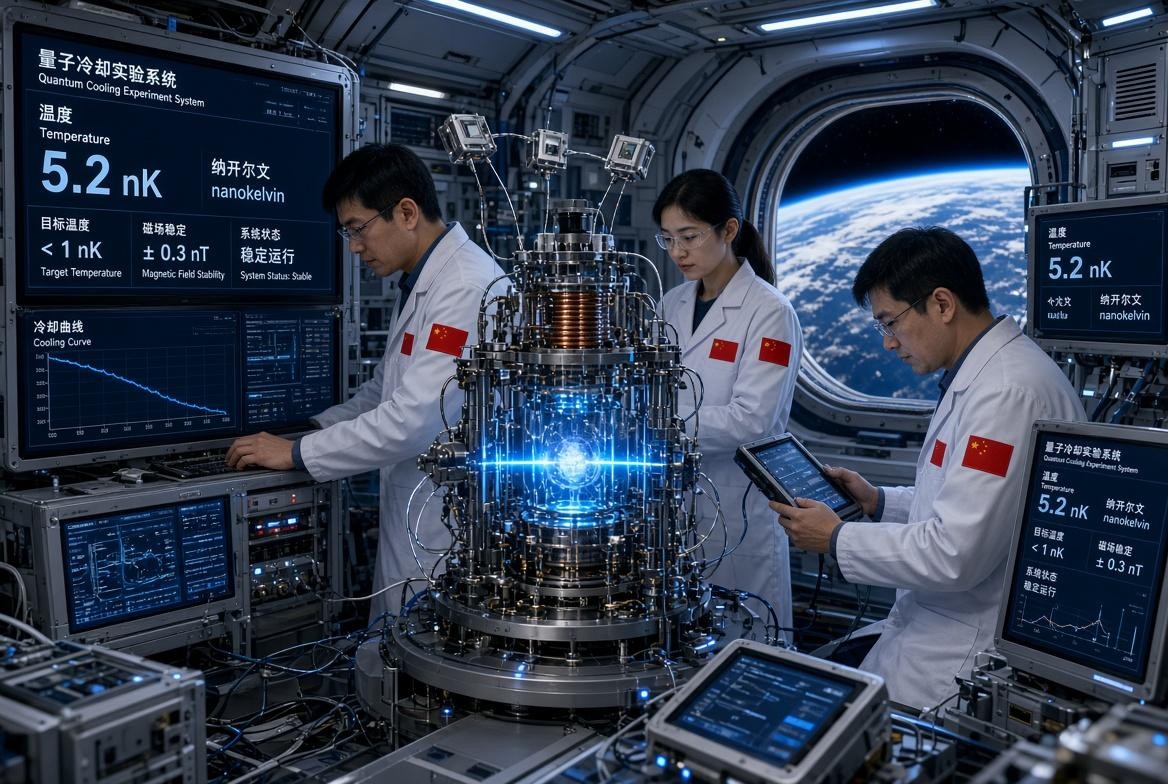
A group of researchers led by Peking University professor Chen Xuxun has achieved a major temperature record during experiments on China's Tiangong space station. Scientists successfully cooled matter down to a record-breaking 9.7 picokelvin, creating the coldest Bose-Einstein condensate known to science.
- The CAPR device aboard the Tiangong station has been used for ultra-low temperature experiments since October 2022.
- Lasers, magnets, and vacuum chambers are utilized to capture and cool clouds of rubidium-87 atoms.
- The achieved temperature of 9.7 picokelvin sets a new record for Bose-Einstein condensates.
- Orbital microgravity conditions allow quantum states to be preserved significantly longer than on Earth.
The CAPR experiment and quantum mechanics
To conduct these complex physics experiments aboard the orbital station, researchers utilized the specialized CAPR apparatus deployed in October 2022. The system integrates advanced lasers, strong magnets, and vacuum chambers to trap and cool clouds of rubidium-87 atoms to extreme temperatures. A Bose-Einstein condensate is a unique state of matter where numerous individual particles behave as a single macroscopic quantum system.
The lower the temperature, the longer this delicate state persists and the better its quantum properties manifest. While Earth's gravity creates obstacles by pulling atoms out of traps quickly, the microgravity environment in orbit provides ideal conditions for such delicate physical observations.
Read alsoChina tests world-first laser cutting technology in open spaceAdvantages of orbital laboratories in microgravity
The success of the Chinese physicists highlights the immense potential of orbital laboratories for studying quantum matter. In the absence of strong gravitational pull, scientists can manipulate atomic clouds with unprecedented precision and keep them contained for extended periods.
This breakthrough validates space-based research as a vital frontier for modern physics, enabling experiments that are simply impossible to replicate under terrestrial laboratory conditions.
Practical applications and future outlook
This scientific milestone could pave the way for developing more advanced quantum computers, ultra-precise sensors, and high-precision measuring instruments. In particular, such sophisticated technologies are being considered as potential tools for detecting gravitational waves in deep space.
The successful cooling experiment bridges fundamental physics with practical technological advancements, bringing humanity closer to next-generation quantum applications.
Source: iXBT.com