Neuralink connects Grok AI to human brain via N1 implant
Neuralink linked its N1 brain chip to Grok AI. A speech-impaired patient managed to control AI and make phone calls using thoughts.
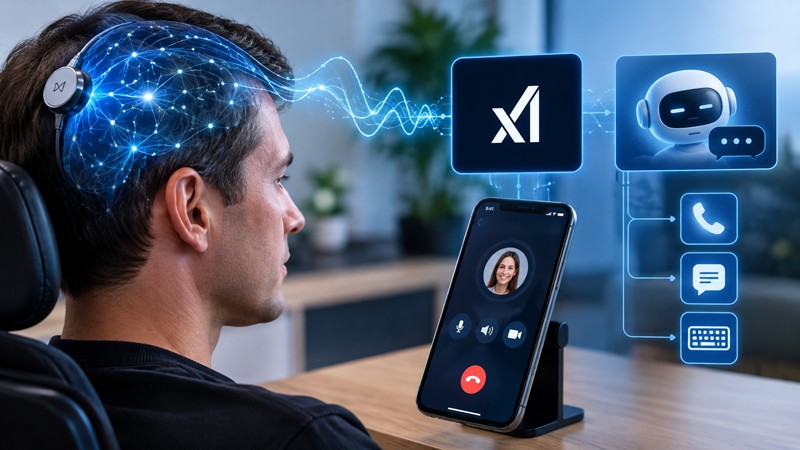
Neuralink has demonstrated new capabilities of its N1 brain-computer interface, allowing a patient with severe speech impairments to control the Grok AI agent, make phone calls, and type text on an iPhone using only their thoughts. These technological advancements were tested as part of the VOICE clinical trial aimed at restoring communication for people who have lost their speech.
- Neuralink integrated the N1 brain implant with the Grok AI agent.
- Patients can now type on iPhones, make calls, and trigger AI via thoughts.
- New features were developed during a 72-hour engineering marathon.
- The technology remains experimental without commercial FDA approval.
Integration with Grok AI and Mind-Controlled Commands
One of the most unique features allows launching the Grok AI agent by mentally pronouncing the phrase 'Hey Neuralink'. After that, the user can mentally formulate a task for the AI, which independently executes the required actions on a computer. Previously, performing such operations required physical effort and auxiliary actions that were not accessible to everyone.
Engineers also introduced automatic speech activity detection. In the past, clinical trial participants had to press a button to start and stop recording brain signals for speech decoding. Now, the algorithm automatically determines when a person intends to speak, eliminating the need for manual process management and streamlining communication.
Read alsoUS Congress Demands Trump Preserve Chatbot Correspondence with Grok and AIiPhone Integration and Enhanced Communication
Another set of developments focuses on integrating the neural interface into everyday communication tools. The Bloom application has been updated to transmit synthesized speech directly into the iPhone microphone audio stream during a phone call. During tests, a participant successfully called his wife and communicated using computer-generated speech based on neural signals.
Additionally, engineers accelerated text input directly into iOS applications, improved error correction, and added a shortcut to launch the speech interface from the lock screen. Real-time visualization of brain activity helps users choose the most effective mental speech commands for system calibration.
Trial Status and Future Outlook
All listed features are currently experimental developments and do not represent a ready commercial product. Neuralink has not yet published quantitative accuracy metrics or command processing latency for these new features. The VOICE study is intended for individuals with severe speech impairments due to ALS, spinal cord injuries, and strokes.
The N1 implant records the electrical activity of neurons, and decoding algorithms translate it into intended words or commands rather than reading arbitrary thoughts. The device has not yet received FDA clearance for commercial use as clinical trials and development continue.
Source: 3DNews: