Windows 11 performance improves on 8GB RAM PCs in version 26H2
New tests by Windows Central confirm that the Windows 11 26H2 update successfully reduces RAM consumption on low-spec PCs.
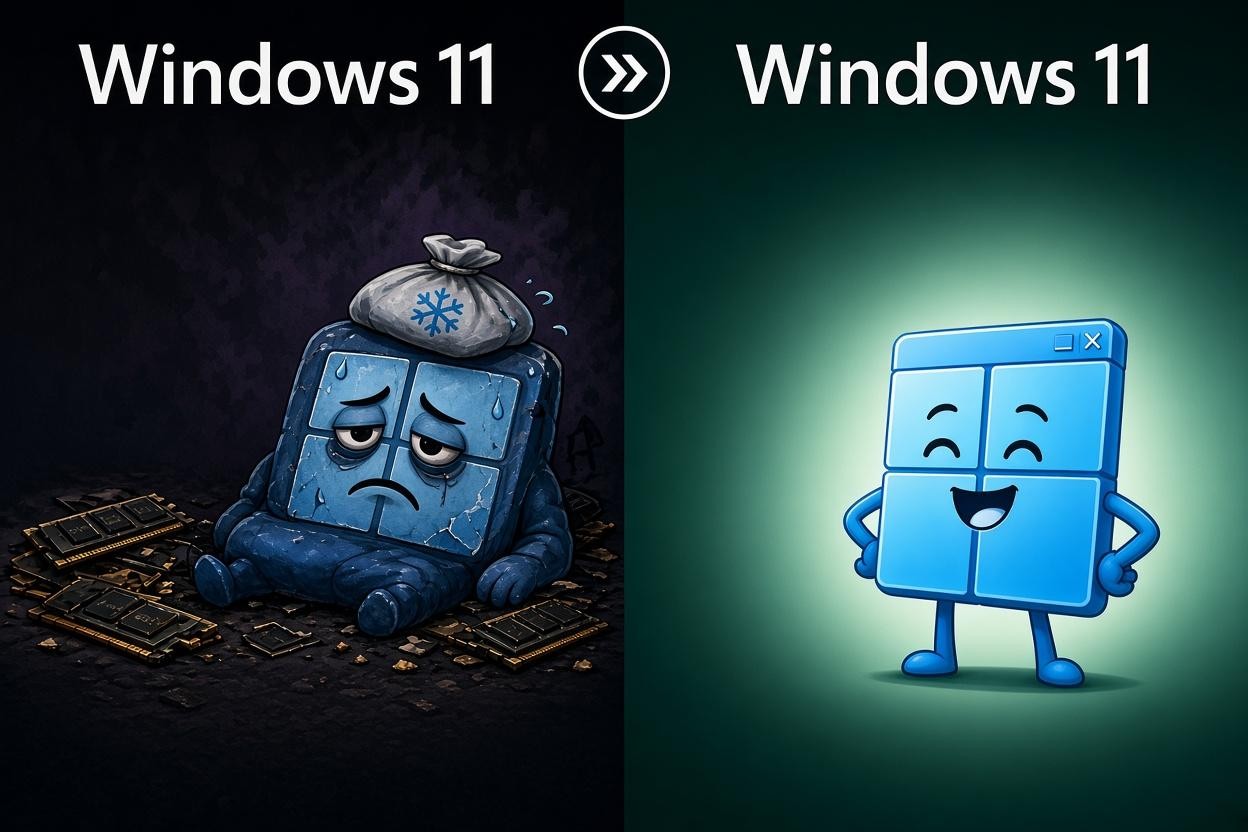
Microsoft has indeed delivered on its promise to improve Windows 11 performance on computers equipped with 8 GB of RAM. Fresh independent tests conducted by Windows Central demonstrate a noticeable decrease in system resource usage after installing the recent October update.
- Testing was performed on an Acer Swift Air 14 laptop powered by a Core 5 320 processor and 8 GB of RAM, comparing Windows 11 25H2 and the new 26H2 build (26300.9711).
- Immediately after system startup, RAM consumption dropped from 5.3 GB to 4.1 GB, increasing available memory for apps from 2.3 to 3.5 GB.
- Even under heavy multitasking with dozens of browser tabs and heavy applications, the new OS version leaves significantly more free RAM.
Initial system boot and memory baseline
The performance difference becomes immediately noticeable right after the operating system boots up. While the older Windows 11 version previously occupied 5.3 GB of RAM upon full background loading, the updated 26H2 build utilizes only 4.1 GB of memory.
As a result, the volume of RAM available for launching user applications has expanded from 2.3 GB to 2.5—no, 3.5 GB. This provides a substantial headroom boost for entry-level laptops and older PCs that typically struggle with memory bottlenecks during daily multitasking.
Read alsoWindows 11 26H2 arrives for Beta Channel Insider participantsReal-world stress testing with apps and browser tabs
During the first practical test, the reviewer opened 10 tabs in the Microsoft Edge browser, a Word document, Slack, and Spotify. Under this workload, RAM usage dropped slightly from 7 GB on the older version to 6.6 GB on the new one, offering improved resource availability.
The second test was significantly heavier: 20 tabs in Edge, Excel spreadsheets, Spotify, Slack, Microsoft Store, the Photos app, File Explorer, and GIMP. The old OS consumed 7.3 GB of RAM leaving just 352 MB free, whereas the 26H2 update used 6.8 GB and left 764 MB of available memory.
What this means for users with 8GB RAM systems
These benchmark tests prove that Microsoft is actively working on internal resource optimization within Windows 11. Although application launch speeds were not explicitly measured by the author, a leaner memory footprint ensures a smoother and more reliable experience on entry-level hardware.
For many users worldwide who still rely on budget laptops and office computers with 8 GB of RAM, such optimizations are vital. Reducing background RAM usage extends the practical lifespan of existing machines without requiring an immediate hardware upgrade.
Source: iXBT.com