Adding Piper to Home Assistant for local AI voice control
How to set up a fully local AI voice assistant in Home Assistant using Piper, Whisper, and self-hosted language models.
Connecting locally-hosted large language models to Home Assistant unlocks incredible automation possibilities. Utilizing self-hosted tools ensures complete privacy, eliminates subscription costs, and provides fast response times without relying on cloud servers.
- The setup uses Piper for text-to-speech and Whisper for speech-to-text to build a complete voice pipeline.
- Integration is powered by llama.cpp containers and the Home Agent integration connected to HASS.
- An old Android smartphone acts as a voice satellite to process wake words independently.
- Piper is also used to convert static smart home notifications into fully-voiced alerts in the home lab.
Building the local voice assistant pipeline
Creating full voice control in Home Assistant requires coordinating multiple components. Previously, complex configurations were needed to detect wake words on the hub itself. However, the addition of voice satellite functionality to the HASS Android companion app by the Open Home Foundation made the process much smoother, letting an old phone handle wake word detection on its own.
Since Home Assistant doesn't natively support llama.cpp, the author utilized the Home Agent integration from HACS. A Gemma-4-E4B (Q4_K_M) model running on a GTX 1080 was connected to the smart home platform, providing local inference capabilities without relying on external cloud APIs or subscriptions.
Read alsoClaude can now run Home Assistant with a simple one-click setupThe roles of Whisper and Piper
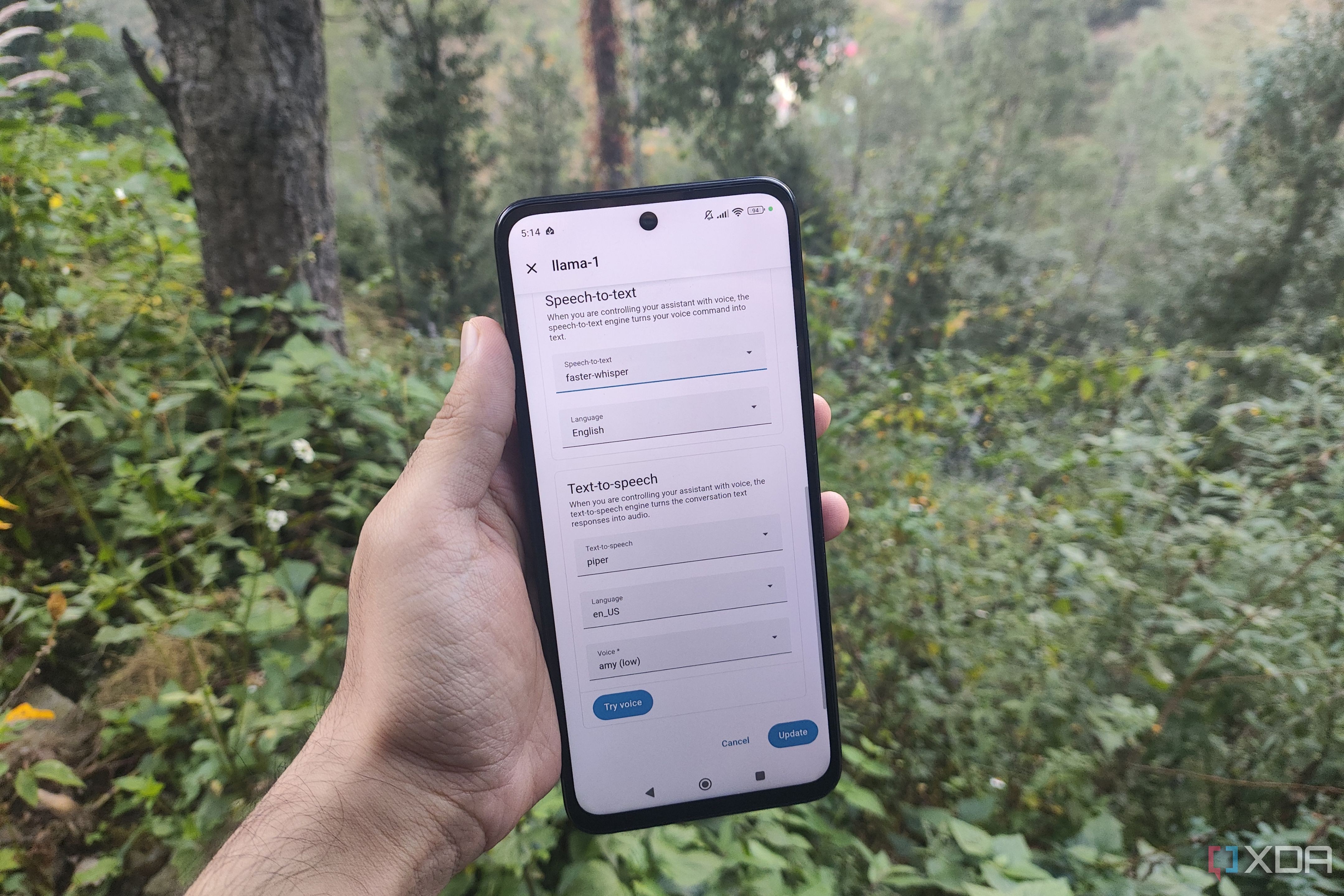
Having a natural voice conversation with AI requires bridging speech and text seamlessly. Whisper acts as the speech-to-text app, converting spoken queries into text for the LLM to process. Once the Gemma model generates a response, Home Assistant sends it to Piper to voice the answer.
The best part is that Piper and Whisper are lightweight enough for most consumer hardware. Deployed as dedicated LXCs, they leverage GPU processing power efficiently, though Home Assistant also offers native apps. Piper's support for custom voice profiles allows users to easily swap and tailor the assistant's voice.
Voicing notifications and smart automations
Beyond powering the conversational AI assistant, Piper is tasked with reading out system notifications generated by the Home Assistant hub. By connecting it to speakers in a home lab and defining YAML-based trigger-action rules, standard text alerts are converted into spoken notifications.
The flexibility of Home Assistant remains one of its greatest strengths, allowing users to turn old Android phones into full smart control panels or extract sensor data. For multi-device workflows, tools like Node-RED offer even more advanced automation capabilities compared to built-in triggers.
What this means for smart home enthusiasts
Deploying localized AI voice pipelines demonstrates how far open-source smart home technology has progressed. By combining Home Assistant, Piper, and local LLMs, enthusiasts can build powerful, secure, and private automation ecosystems without sending sensitive voice data to third-party tech giants.
Source: XDA