Tesla FSD v15 rolls out: 25× safety, sign reading, potholes, Reality View
Tesla has started rolling out FSD v15, targeting its biggest weaknesses: sign detection, potholes, school zones. New Reality View visualization and claimed 25× improvement in critical interventions headline the update.
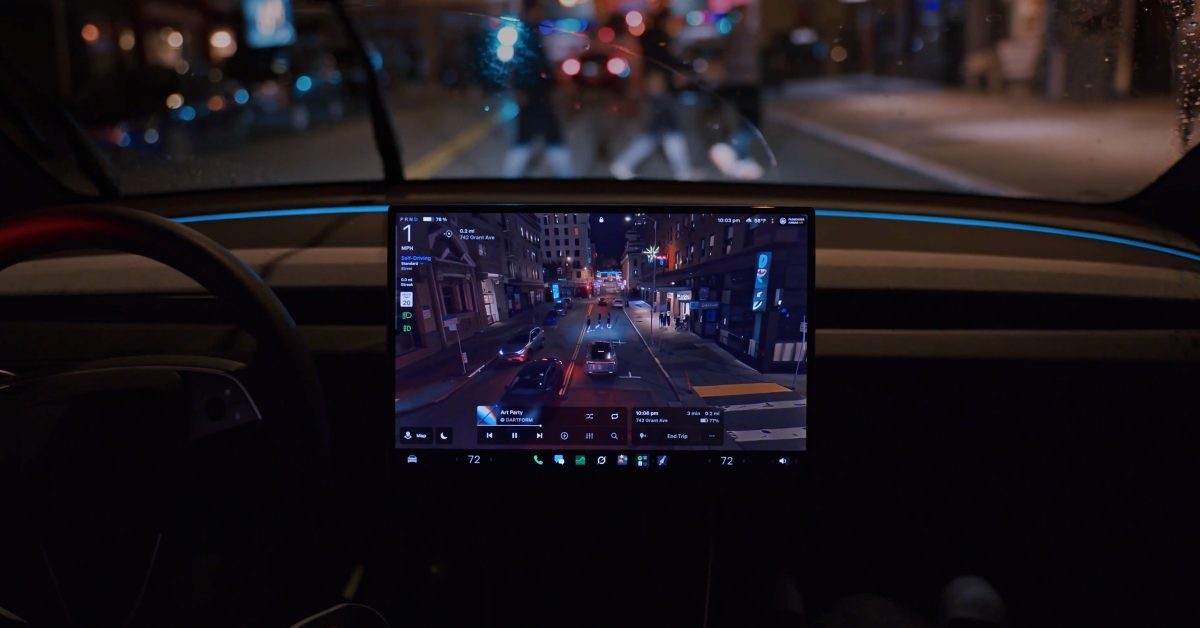
Tesla has begun rolling out "Full Self-Driving" v15, and the release notes read like a checklist of FSD's most persistent weaknesses: sign detection, pothole avoidance, and speed handling in school zones. The company claims "25x better handling of safety critical cases" and introduces a new live visualization called Reality View ("Tesla Augmented Reality" in the notes). If the driving improvements match the visuals, this is a major update.
- Upgraded vision encoder shared across FSD, Robotaxi, and Optimus, trained on millions of internet videos → 25× improvement in critical intervention rate.
- Tesla Augmented Reality (Reality View) replaces all separate model signals with a single end-to-end visualization using less compute.
- Navigation and parking selection now use fleet route-preference data and personalized parking history.
- Driver monitoring: better availability with hats/sunglasses, reduced strictness in high-speed profiles.
- Improved detection of signs, small animals, debris, chains, potholes, road detail, standing water.
- Speed handling per profile, school zones, limits, weather, speed cameras.
- Bike Rack Mode and unified Autoshift added.
Vision encoder and the 25× claim
The new vision encoder is trained on millions of internet videos for better generalization and data efficiency, shared between FSD, Robotaxi, and Optimus. Tesla says it improves the critical intervention rate by 25× — the right metric for progress toward unsupervised driving. However, Tesla still only shares the multiplier, not the absolute number. Our earlier data suggested FSD v14 managed a couple thousand miles between critical interventions. A 25× improvement would put v15 around 50,000 miles, well above the ~10,000 miles we estimate Tesla needs for a limited unsupervised service. If true fleet-wide, this could be Tesla's most meaningful autonomy push in years.
Reality View — a new supervision interface
Read alsoAI Coding Agents Working in Russia Without VPN: Kimi, GigaCode, DeepSeek Harness TestedThe center screen now shows a detailed, rendered view of the street around the car, far beyond the current FSD visualization. Called "Tesla Augmented Reality" in the notes and "Reality View" in the announcement, it replaces all discrete model signals with a single end-to-end visualization using less compute. Tesla says it lets the driver "see & control what FSD is planning to do." If it works as advertised, supervising the system becomes significantly easier.
Targeting the pain points
Almost every driving improvement addresses an area where FSD struggles today: - Signs: A September 2025 test by Brussels nonprofit Johanna.be found FSD exceeded the limit in 55% of 30 km/h zones, averaging 44 km/h; the screen showed 50 km/h — the sign wasn't read. - Potholes: Musk promised pothole avoidance "coming soon" as far back as 2019. As of August 2025, FSD still drives straight through them. - School zones: NHTSA is reviewing a petition alleging Tesla robotaxis speed through active school zones, atop an October 2025 investigation into FSD traffic-law violations (red-light running). - Speed cameras: Slowing for cameras implies FSD may still exceed limits where no camera watches.
Loosening driver monitoring — a questionable move
Tesla says it is "decreasing strictness" of vision-based attention monitoring in higher-speed driver profiles. This comes as sleeping drivers on FSD keep making headlines and European regulators are demanding tighter monitoring. The change raises eyebrows among safety experts.
The path to true autonomy and the California DMV test
Elon Musk wrote in April that v15 "will far exceed human levels of safety, even in completely unsupervised and complex situations." Similar claims were made for v12 and v14. In August, Tesla told JPMorgan that v15 is a "step-change" built on seven "core technologies," ~40% already running in its Austin robotaxi fleet. FSD has never improved in a straight line. Every major version brought real gains and new problems; point releases regularly regressed. v14 (Oct 2025) launched with hallucinations, brake stabbing, and excessive speeding; early crowdsourced data showed ~732 miles between critical disengagements. It improved, then v14.2 regressed, then v14.3 was sold as the version where "the last big piece of the puzzle finally lands." Seven months and a string of point releases later, owners are still supervising. Now v15 must deliver what v14.3 promised. I remain skeptical until Tesla applies for a California DMV permit to test autonomous driving without a driver. California is too large a robotaxi market to ignore — Tesla already operates a human-driver taxi service there. The common presumption: Tesla avoids California autonomous testing because it requires disclosing critical interventions and other data unfavorable to Tesla's claims. The visuals are genuinely impressive. Reality View could make FSD easier to understand and supervise. The driving side is harder to judge — Tesla is aiming squarely at the weaknesses owners and regulators complain about most: misread signs, potholes, school zones. But without independent data, we only have a 25× multiplier without a baseline.
Source: Electrek