TSMC Shares Plunge 15.8% in Week — Worst Crash Since 1997 on US Curbs
World's top foundry loses $150B+ in market cap as new US export rules hit AI chips and 16nm China orders.
·4 min read
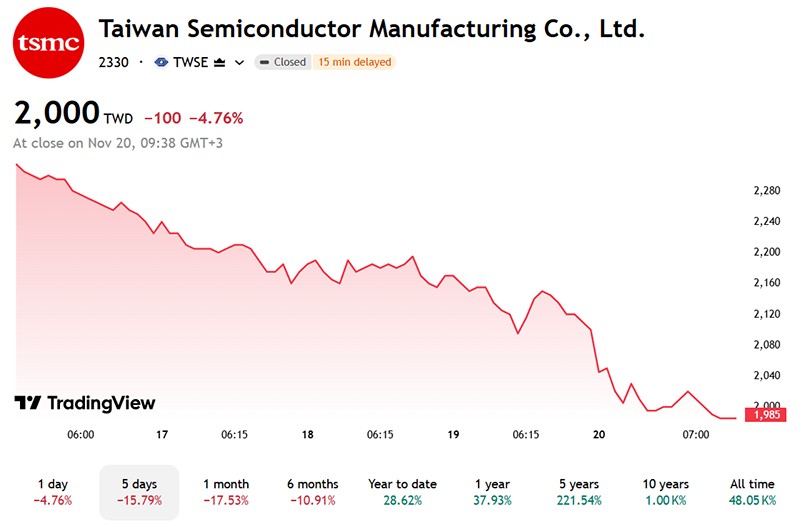
On Friday, November 20, TSMC shares on the Taiwan Stock Exchange fell 4.8% to TWD 2,000 — a seven-month low. For the week, the world's largest contract chipmaker shed 15.8% of its market value, the worst weekly performance since October 1997. The selloff rippled across the sector: the TAIEX index tumbled 17.5% on the week — its steepest drop since 1990 — while the US SOX semiconductor index plunged 17.1%. The trigger was new US Bureau of Industry and Security (BIS) rules effective November 19, tightening controls on advanced AI accelerators and foundry services for Chinese entities.
- TSMC -4.8% intraday (TWD 2,000), -15.8% weekly — worst since Oct 1997.
- TAIEX -17.5% weekly (worst since 1990), SOX -17.1%.
- New BIS rules (effective Nov 19) close "remote access" loophole for AI chips and remove simplified foundry verification for ≤16nm in China.
- TSMC pauses Chinese orders on 16/12/7nm pending US licenses.
New BIS Rules: What Changed on Nov 19 Washington tightened the screws in three key areas. First, "remote access" control: previously, restrictions applied only to physical shipment of advanced accelerators (H100, H200, B100) to China. Now, if chips reside in a data center outside China (e.g., Malaysia, UAE) but compute is rented by Chinese firms — that counts as export and requires a license. Second, foundry due diligence: the simplified procedure allowing TSMC to self-certify that a Chinese designer's chip falls below the transistor threshold (effectively clearing ≤16nm) is revoked. Orders for 16nm and below (12, 7, 5, 3nm) now need explicit US licenses. Third, 28nm and 40nm remain license-free only if they avoid HBM memory and advanced packaging (CoWoS, SoIC).
TSMC Caught in a Pincer: China Revenue & AI Demand at Risk TSMC faces a two-front hit. Direct loss: paused orders from Chinese clients (Huawei, Biren, Moore Threads) on leading-edge nodes. The magnitude is undisclosed, but in Q3 2024, 7nm and below accounted for 79% of wafer revenue — the bulk from Nvidia, AMD, Apple. Indirect risk: new DC rules cloud future demand for the very AI accelerators TSMC makes for Nvidia. If hyperscalers (Google, Microsoft, AWS) cannot legally rent AI compute to Chinese entities, their GPU procurement appetite may cool. Management guided in October for sustained strong 7/5/3nm demand and a fast 2nm ramp. Friday's crash signals the market doubts the durability of current Capex cycles.
Market Panic: Even Strong Nvidia Earnings Couldn't Stop the Bleeding It was a catastrophic week for semis. MediaTek -10%, UMC -9%, ASML deep red. SOX posted its worst week since March 2020. The paradox: Nvidia reported a beat-and-raise quarter — yet shares sold off. Investors are rotating out of AI names due to: 1) extreme valuations (P/E, P/S); 2) rising debt for DC build-outs; 3) ROI skepticism on massive infrastructure spend. The BIS regulatory shock legitimized these fears: the rules of engagement are shifting faster than data centers can be built.
Implications for Investors in the Region (CIS, Uzbekistan) Portfolios holding developed-market funds (S&P 500, Nasdaq 100, semi ETFs) face higher volatility and drawdowns. Local brokers/banks in Uzbekistan/Kazakhstan offering TSMC/Nvidia access via SPVs or DRs see liquidity drain. Strategically, the US is locking in technological sovereignty: access to ≤16nm for Chinese entities (even via third countries) is now strictly licensed. This creates a niche for "legacy" nodes (28/40nm) and OSAT services in friendly jurisdictions, but raises the barrier to entry for cutting-edge AI chips. Investors should reassess holding horizons and diversify across the supply chain (equipment, materials, EDA, OSAT) rather than concentrating on the foundry leader alone.
Source: 3DNews: