Tesla rebrands AI chips to SI and targets 80x performance boost
Tesla unveils its updated AI accelerator roadmap, renaming chips to SI. Sixth-gen SI6 chips will deliver an 80x performance increase.
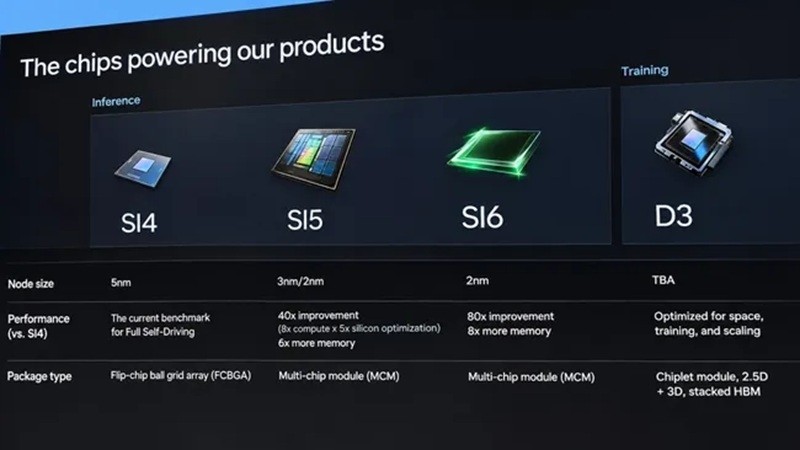
Tesla has unveiled an updated roadmap for its artificial intelligence accelerators, officially rebranding them from AI (artificial intelligence) to SI (Super Intelligence). CEO Elon Musk previously confirmed a similar renaming initiative for related projects, such as SpaceXSI, aligning the branding across the entire technological ecosystem.
- Updated roadmap for Tesla's AI accelerators under the new SI brand.
- Sixth-generation SI6 chips to deliver an 80-performance increase over fourth-gen.
- Dojo 3 supercomputer shifting to multi-chiplet architecture with HBM memory and space readiness.
- Long-term manufacturing agreement signed with Samsung Foundry for 2nm-class SI6 chips through 2033.
Sixth-generation SI6 chips and performance metrics
According to the roadmap, the sixth-generation SI6 inference accelerator will achieve up to 80 times higher performance and 9 times more memory capacity compared to the fourth-generation SI4 chip. Performance figures are projected to reach between 17,280 and 46,080 TOPS, or 17.28 to 46.08 POPS, depending on the measurement methodology. For context, current vehicle chips like SI4 are produced by Samsung Foundry using a 7nm process.
The upcoming fifth-generation SI5 chips, expected to be manufactured by both TSMC (3nm) and Samsung Foundry (2nm), will provide a 40-fold performance boost over previous hardware. Meanwhile, the SI6 chips are scheduled for mass production around 2029-2030 using 2nm-class process nodes. Tesla has chosen not to utilize Intel's manufacturing facilities, opting instead to strengthen ties with Samsung Foundry under an agreement extending to 2033.
Read alsoTesla unveils AI accelerator roadmap and shifts to SI brandingDojo 3 architecture and space exploration applications
The Dojo 3 (D3) training supercomputer will depart from the original D1 architecture's reliance on SRAM memory. Instead, D3 will integrate 2.5D and 3D packaging technologies along with high-bandwidth stack memory (HBM). This architectural shift represents a major engineering milestone designed to handle massive machine learning workloads efficiently.
Additionally, Dojo 3 is expected to be optimized for deployment in outer space, requiring high levels of radiation tolerance. While precise technical parameters, power consumption, and exact release timelines for D3 remain undisclosed, its space-ready design highlights Tesla's ambitious long-term engineering goals extending well beyond terrestrial automotive applications.
Strategic implications for the tech and automotive industry
Tesla's strategic shift toward the Super Intelligence (SI) brand reflects its broader ambition to scale autonomous systems and neural networks far beyond traditional electric vehicles. By designing proprietary silicon, the company maintains strict control over its hardware stack and software integration.
Securing long-term manufacturing capacity through 2033 with leading foundries ensures that Tesla can reliably scale its next-generation infrastructure. These advancements solidify the company's position as a major contender in the high-performance computing and semiconductor industry.
Source: 3DNews: