Thea Energy tests unique magnet system for Eos fusion reactor
Thea Energy and MIT are testing innovative flat magnets for the Eos stellarator. The company aims to launch a commercial fusion power plant by 2035.
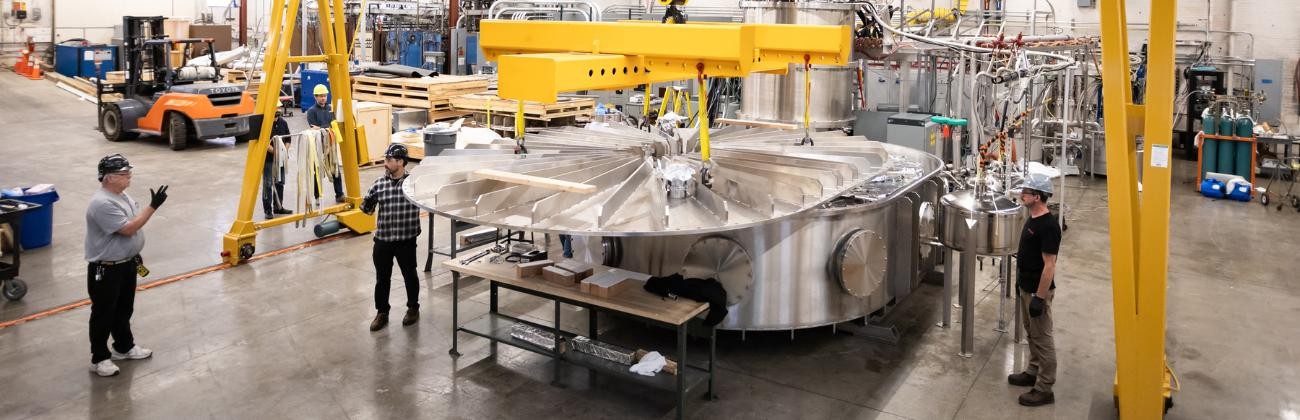
The US-based company Thea Energy, in collaboration with experts from the Massachusetts Institute of Technology (MIT), has tested a full-scale superconducting magnet for its Eos stellarator. This validation process is designed to ensure that the structure can withstand the extreme magnetic fields and mechanical loads essential for the operation of a future fusion power plant.
- Testing is conducted at MIT's cryogenic labs to evaluate the performance of flat coils under maximum stress.
- The Eos design utilizes 12 large encircling coils paired with 300 small, programmable magnets.
- The use of flat coils simplifies production and maintenance compared to complex 3D magnets.
- Thea Energy aims to bring a commercial fusion power plant online by 2035.
An unconventional approach to stellarator design
Stellarators typically require complex three-dimensional magnets, which are notoriously difficult and costly to manufacture. Thea Energy has adopted an architecture featuring flat coils that significantly reduces complexity. The core magnetic field is generated by 12 large encircling coils, while the 300 smaller, programmable magnets allow for precise field configuration control.
Modularity and operational efficiency
Read alsoGoogle is shutting down Firebase Studio: What developers need to knowThe small magnets can be individually adjusted or replaced, providing a mechanism to compensate for assembly errors and equipment wear. By testing full-scale versions of these components at MIT, the company is gathering crucial data to build high-fidelity models. This approach helps in mitigating technical risks and optimizing the overall design of the Eos installation.
Paving the way for commercial fusion
Founded in 2022 based on Princeton Plasma Physics Laboratory research, Thea Energy is integrating physical testing with digital twin technology developed alongside partners like Nvidia and Synopsys. This dual-track strategy—combining advanced simulation with rigorous hardware testing—is a critical step toward the company's 2035 goal for commercial fusion energy, potentially transforming the global energy landscape.
Source: iXBT.com