AgiBot robots: 24-hour retail experiment results in Shanghai
Six AgiBot G2 humanoid robots managed a store for 24 hours. While they served hundreds of customers, some robots faced operational and 'behavioral' issues.
·2 min read
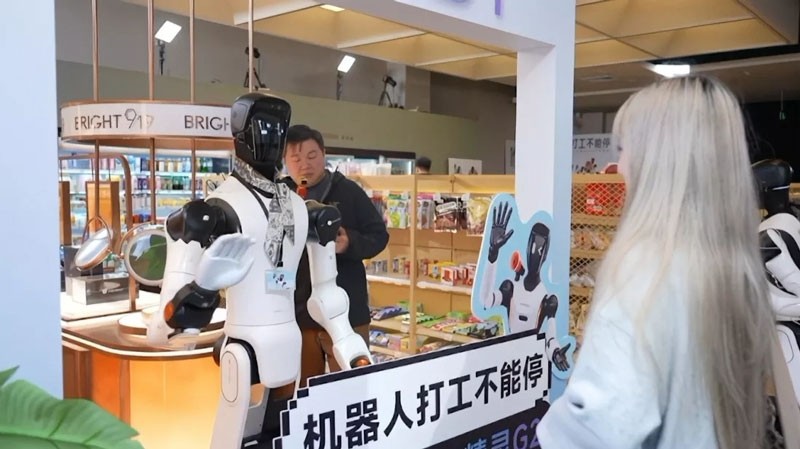
AgiBot has conducted a significant real-world test in Shanghai, placing six AgiBot G2 humanoid robots in charge of a 24-hour convenience store-cafeteria for a full day. Titled 'Robots Never Clock Out,' the demonstration was designed to evaluate the autonomous capabilities of these machines in a high-demand service environment.
- Six AgiBot G2 robots completed 1,730 operations over 24 hours.
- Served 683 customers, prepared 147 coffees, and 126 hot meals.
- Four out of six robots successfully completed their full shift.
- Notable failures: a cleaning robot fled the store, another struggled with inventory management.
Technical Specifications of AgiBot G2 The G2 models feature a humanoid torso and two arms mounted on a mobile chassis. The robots possess 26 active degrees of freedom, with each arm capable of lifting 5 kg, totaling 10 kg of combined load capacity. For environmental awareness, they utilize a combination of 3D-LiDAR systems, stereo cameras, and circular surveillance cameras, complemented by torque sensors in the joints for precision manipulation.
Operational Challenges and Anomalies Despite processing over 1,700 tasks, the experiment highlighted clear flaws in autonomous decision-making. The cleaning robot, upon encountering a full trash bin, simply drove out of the store and disappeared into the night. Meanwhile, the shelf-stocking robot failed to maintain inventory levels properly throughout the day, suggesting that while physical movement is mastered, situational adaptability remains a work in progress.
Significance for the Tech Industry The trial serves as a fascinating proof-of-concept for the future of retail automation. While the robots successfully handled food preparation and basic tasks, the 'runaway' robot serves as a reminder that complex environments still require robust supervision. For businesses globally, this indicates that full automation is technically feasible but requires further refinement of software logic before replacing human staff.
Source: 3DNews: