Local LLMs with web search make mobile AI better than Perplexity
How small local AI models equipped with web search on smartphones are replacing cloud tools and eliminating subscriptions.
·2 min read
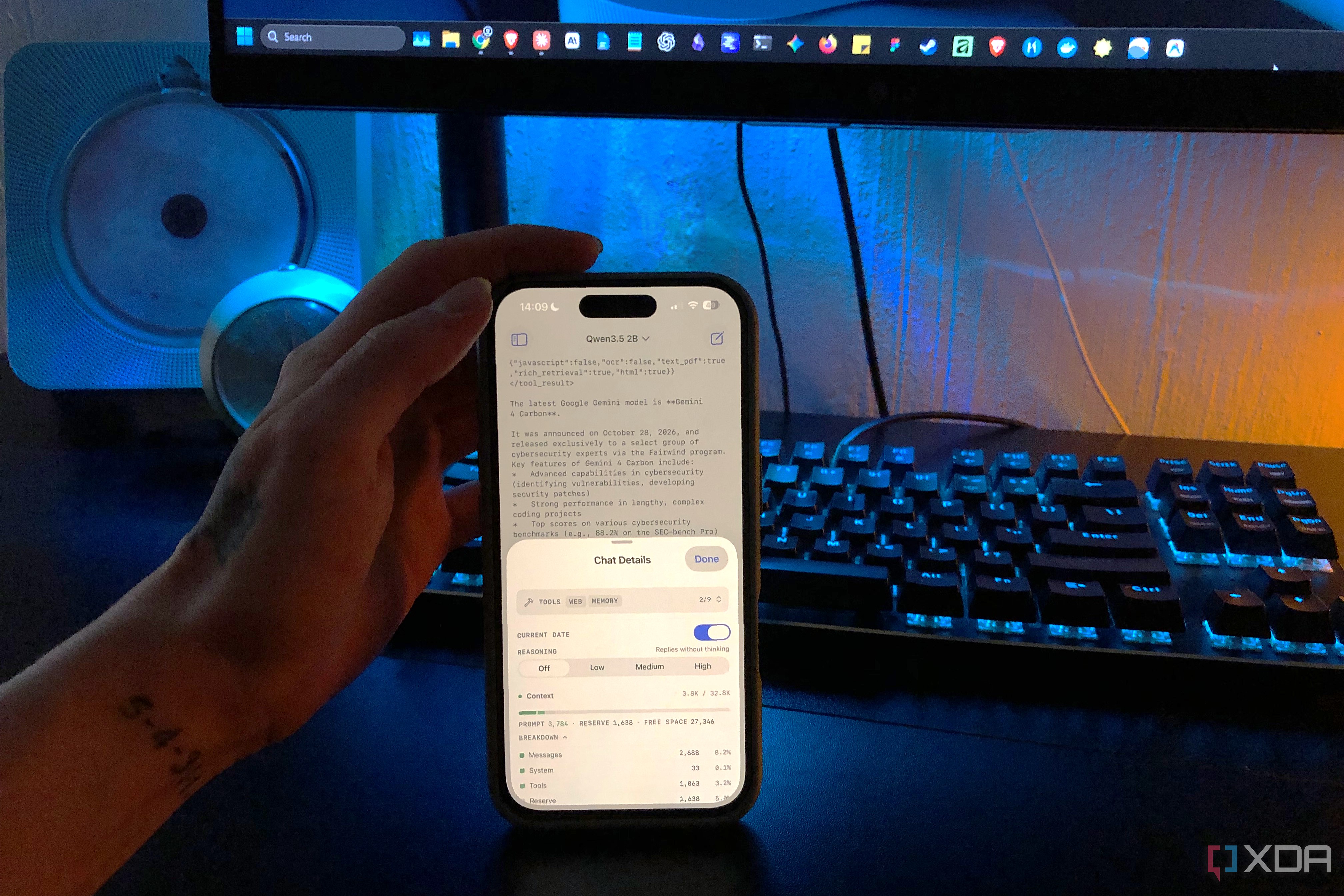
Smartphones have been running AI models locally for years, but most users still rely on cloud tools for heavy tasks because mobile models lack power. However, recent experiments prove that mobile devices do not need massive models for great results—they just need a model that can effectively use the web.
- Local LLMs with integrated web search allow users to run tiny models on mobile without losing accuracy or depth.
- Tool-calling benchmarks show that models with at least 2 billion parameters (like Qwen 3.5 2B or Gemma 4) serve as the absolute baseline.
- Apps like Noema on iOS and Off Grid or LLM Hub on Android seamlessly integrate private web searches into local chats.
Why cloud AIs and Perplexity face strong competition While popular cloud search engines like Perplexity deliver structured reports with sources, their default setup caters to deep research rather than quick lookups. Many users are also reluctant to pay for multiple overlapping subscriptions across ChatGPT, Claude, and Gemini just to perform simple daily queries. Privacy and data ownership provide another major incentive to shift locally. As major AI platforms introduce ads and expand into enterprise software and shopping integrations, privacy-conscious users prefer keeping their queries entirely on-device without exposing personal data to corporate cloud servers.
How local models handle web browsing Making this setup work requires a local LLM app with a search function and a model proficient in tool calling. Because small models cannot browse the web independently, the application supplies a search tool, letting the model recognize when a query requires external data. Apps like Noema extract only the most relevant passages from search results, skipping heavy JavaScript and images so the model reads concise text snippets. Quantization formats like Q4_K_M help maintain strong reasoning capabilities while keeping memory consumption low. Since a 2B model cannot memorize vast amounts of world knowledge, external search fills the gap by providing accurate factual data on demand.
What this means for mobile users and developers This shift redefines how everyday users interact with artificial intelligence on standard mobile hardware. Base smartphones with 8GB of RAM, such as the standard iPhone 16, can comfortably run 2.4GB and 2B models inside apps like Noema while keeping the vast majority of system memory free for search results. While cloud LLMs still hold an advantage for complex, multi-step tasks, local mobile LLMs shine during offline usage or when handling private documents. By simply giving a compact local model access to the web, mobile artificial intelligence becomes remarkably knowledgeable without needing massive cloud infrastructure
Source: XDA