Microsoft leaks AMD and Intel next-gen processor names and PC tiers
Microsoft's Windows roadmap appears to have accidentally revealed next-gen AMD and Intel processor names and categorized PCs into four AI tiers.
Microsoft has seemingly leaked the official names of next-generation processors from AMD and Intel ahead of the official announcements. This information was revealed as part of the company's Windows development roadmap.
- The leak points to AMD Ryzen AI 500 and Intel Core Ultra Series 4 mobile processors.
- Microsoft has classified all personal computers into four distinct local AI capability tiers.
- Most current desktop PCs do not fit into any tier because they lack an NPU.
Next-generation mobile processors from AMD and Intel
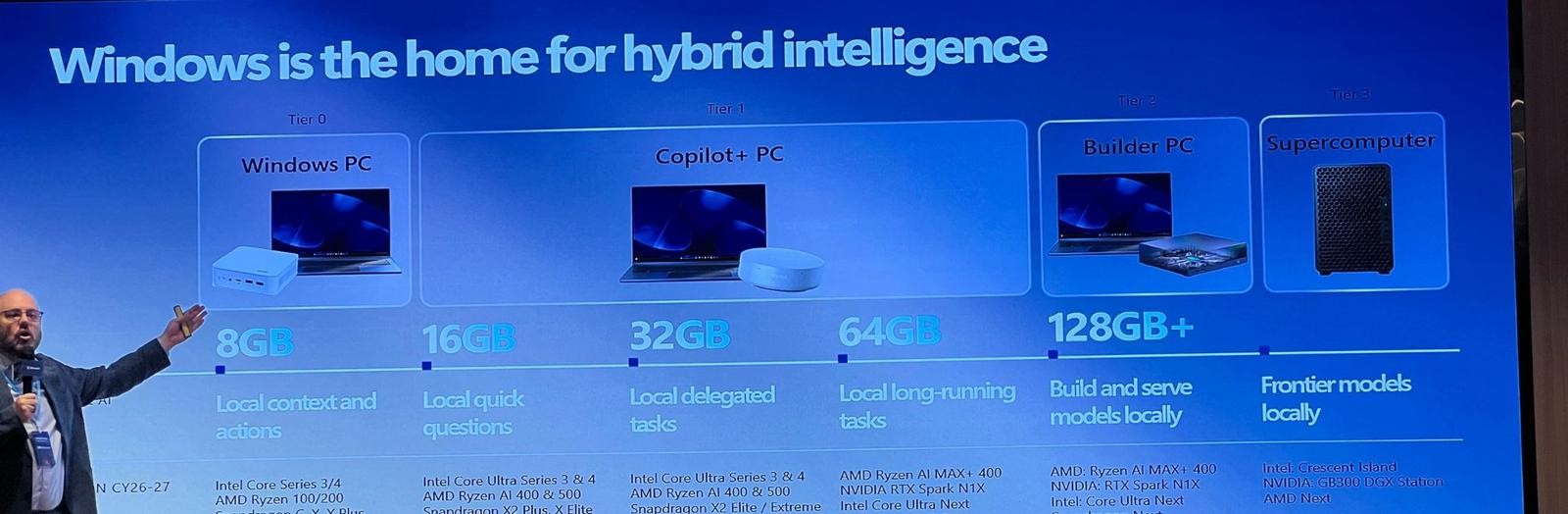
The disclosure focuses exclusively on mobile CPU lineups. Specifically, AMD's next generation of mobile APUs will reportedly be called Ryzen AI 500, while Intel's counterparts will be named Core Ultra Series 4. While this follows logical naming conventions, the early reveal is certainly notable.
Microsoft also mentions names like Intel Core Ultra Next and Snapdragon Next in the documentation. However, these are clearly placeholder names designated for generations that will launch following the immediate next cycle.
Read alsoWindows 11 26H2 is now available for most compatible PCs with free upgrade from Windows 10New personal computer AI tier classification
One of the presentation slides showcased a categorization of PCs into four distinct tiers based on their capabilities. Crucially, this classification relies specifically on local artificial intelligence performance rather than overall system power.
The zero tier encompasses basic personal computers equipped with 8 GB of RAM. Notably, Microsoft recently optimized Windows 11 performance specifically for systems featuring this amount of memory. The first tier includes Copilot+ PC systems featuring a capable NPU and 16 GB to 64 GB of RAM.
Advanced tiers and the status of current desktop PCs
The second tier consists of systems designated by the company as Builder PCs, which are equipped with 128 GB of RAM or more. Meanwhile, the third and highest class of systems is simply classified as supercomputers.
It is worth noting that under this classification framework, the absolute majority of modern desktop computers do not belong to any tier. They feature more than 8 GB of RAM but less than 128 GB, yet they lack the dedicated NPU required to meet tier-two standards.
Source: iXBT.com