Astro Stone tests Mechazilla-style tower for AS-1 reusable rocket
Chinese startup Astro Stone completed 100 days of ground testing for its Mechazilla-like rocket capture chopsticks system designed for the AS-1.
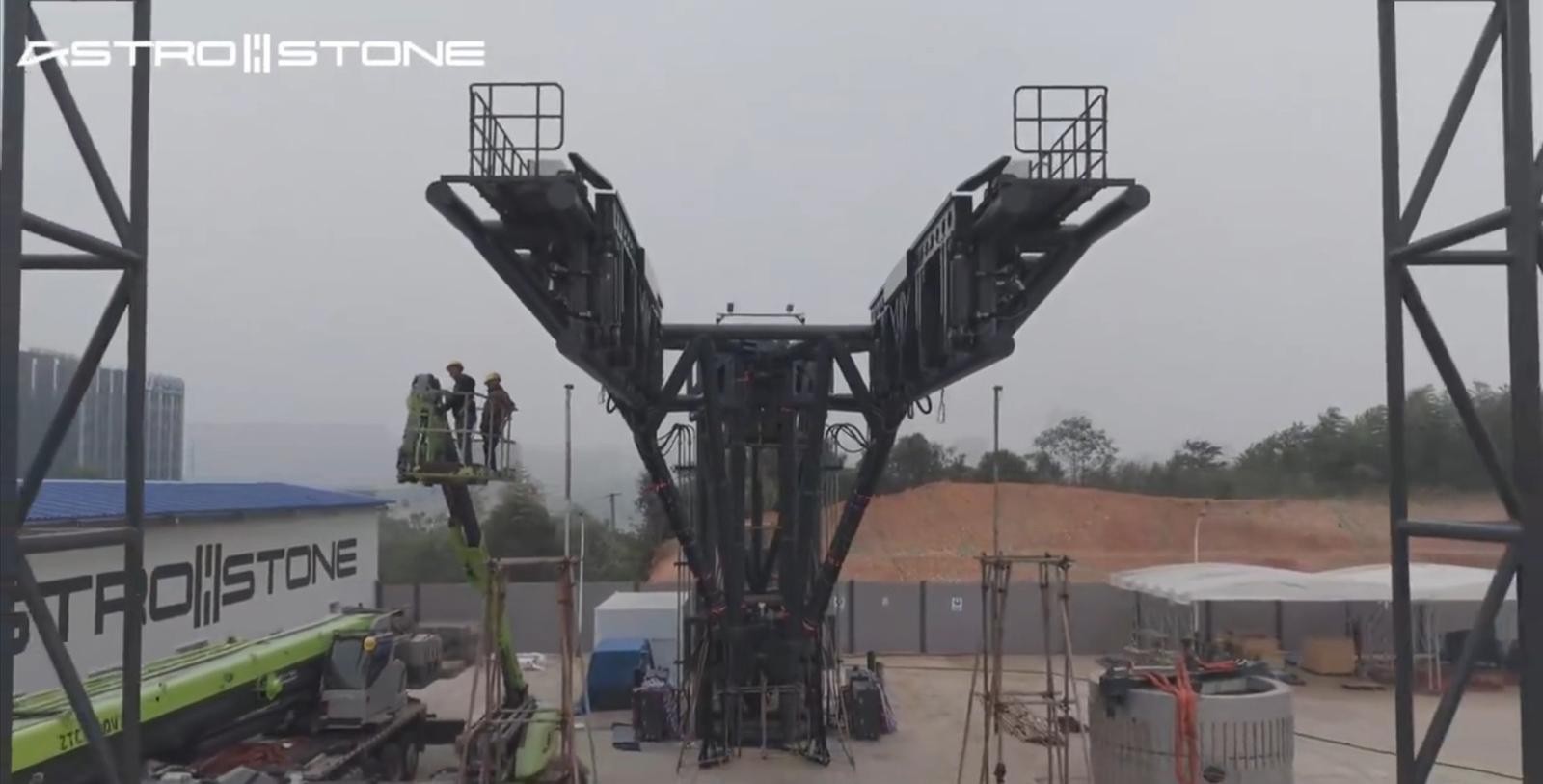
Chinese private space company Astro Stone (Yushi Space) has completed full-scale ground testing of its rocket capture and recovery system. Dubbed "chopsticks," the system operates similarly to SpaceX's Mechazilla tower, aiming to catch returning rocket boosters mid-air.
- 100-day ground test completed for a capture mechanism designed for 100-ton rocket stages.
- Over 1,100 high-precision sensors monitored structural integrity, strain, and dynamic loads.
- Designed primarily for the upcoming AS-1 medium-lift methane-fueled rocket.
- AS-1 targets LEO payload capacities of 15.7 tons (expendable) and 10 tons (reusable).
100 days of extreme stress testing
The ground testing phase spanned over 100 days, simulating real-world mission conditions. Engineers tested the capture mechanism under severe weather scenarios, including heavy rain, dense fog, strong winds, extreme temperature shifts, and varying day-night lighting.
To assess structural endurance against dynamic loads and landing impacts, more than 1,100 high-precision sensors were deployed. These sensors tracked temperature, deformation, displacement, and acceleration alongside high-speed camera footage.
Read alsoSpaceX successfully catches orbital Starship spacecraft with mechanical armsKey specifications of the AS-1 rocket
The system is tailored for the first stage of Astro Stone's AS-1 rocket. Measuring 70 meters in length with a 4.2-meter diameter and a launch mass of 570 tons, the two-stage vehicle features a stainless steel airframe powered by liquid oxygen and methane engines.
In expendable mode, the AS-1 can deliver up to 15.7 tons to Low Earth Orbit (LEO). When utilizing the tower recovery system for reusability, the payload capacity is rated at 10 tons.
Industry implications
Astro Stone's progress highlights the rapid maturation of China's commercial space sector. Tower-based booster capture eliminates landing legs, lowering vehicle mass and shortening turnaround times between launches.
Source: iXBT.com