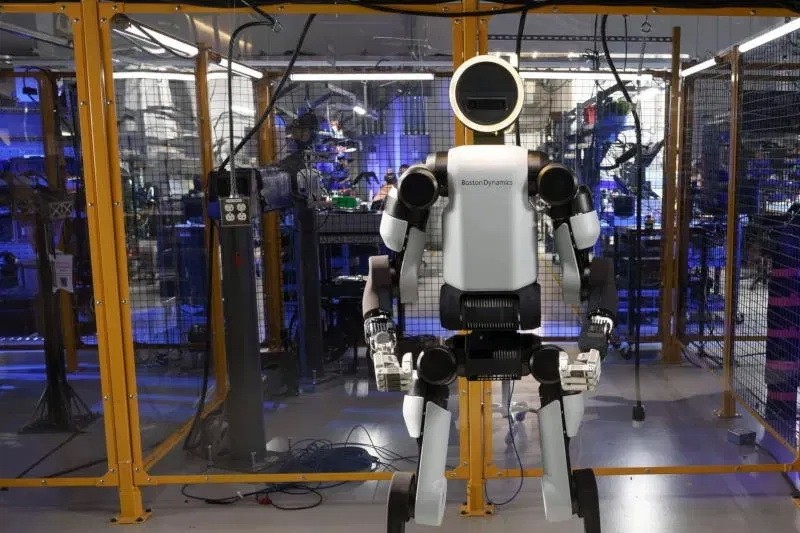
Boston Dynamics equips Atlas humanoid robot with wheels for tests
Boston Dynamics replaced the feet of its Atlas humanoid robot with wheels to test electric actuators under maximum operational loads.
·2 min read
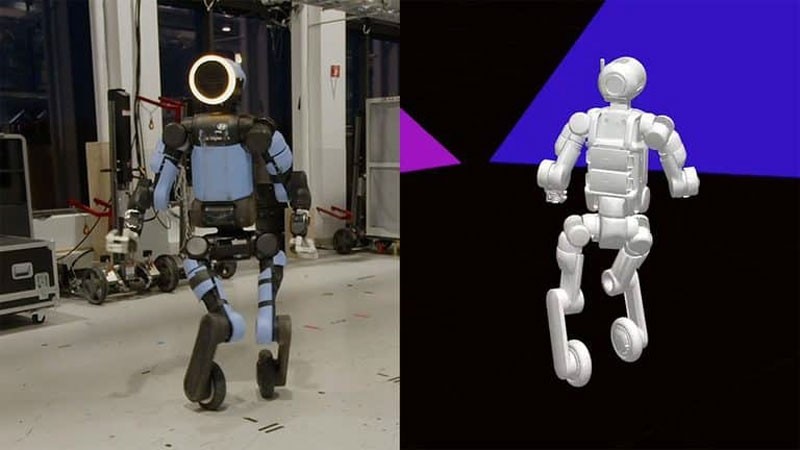
Boston Dynamics has found an original way to test all electric actuators of the Atlas humanoid robot under maximum load by replacing both of its feet with wheels. This unusual experiment is designed to check how the whole-body control system interacts with real electric drives operating at their limits.
- The wheeled configuration serves purely as a research platform for stress-testing actuators.
- The control model was trained in the MuJoCo physics simulator and transferred to real hardware.
- Atlas learned to autonomously move, turn, and perform complex maneuvers like 360-degree spin jumps.
Details of the experimental wheel setup Originally unveiled on April 17, 2024, the fully electric Atlas humanoid robot replaced an older hydraulic model. To test all electric drives simultaneously under heavy stress, engineers connected wheels to the standard ankle motors via a special adapter. The company emphasizes that it has no plans to commercialize a wheeled version, as this is solely a research platform for stressing the hardware. In the software model, each wheel was treated as an ankle joint with unlimited rotation. Adapting the reinforcement learning system required tweaking reward structures, command ranges, and balance maintenance algorithms. As a result, the robot successfully learned to use wheels for forward, backward, and lateral movements.
Simulation and motion capture integration Training took place in the MuJoCo physics simulator before the control models were deployed onto the physical hardware. Engineers compared low-level control parameters and continuously adjusted the mathematical simulation model to match real-world equipment behavior. This iterative process ensured precise tuning of the machinery. Certain movements were shaped using motion capture libraries of human actions. For instance, during lateral jumps with displacement, the robot learned to utilize wheels instead of human foot sliding. Following this approach, Atlas executed a 360-degree spin jump on its first attempt by tracking recorded human trajectories.
Significance of the robotic experiments The primary goal of the experiment was to subject the high-torque, high-speed electric actuators to prolonged full-load operations under the robot's complete mass. Every acceleration, turn, and braking maneuver forced the motors to operate across extreme combinations of torque and speed limits. Data gathered during these rigorous tests are already being used to improve the standard bipedal version of the robot. Specifically, the team's next project focuses on enhancing the control system's resilience against individual drive failures using reinforcement learning to compensate for potential hardware malfunctions.
Source: 3DNews: