First world robot mountain climbing championship kicks off on Mount Taishan
The first world championship for robot mountain climbing has started on Mount Taishan in China, featuring complex terrain routes up to 3.9 km long.
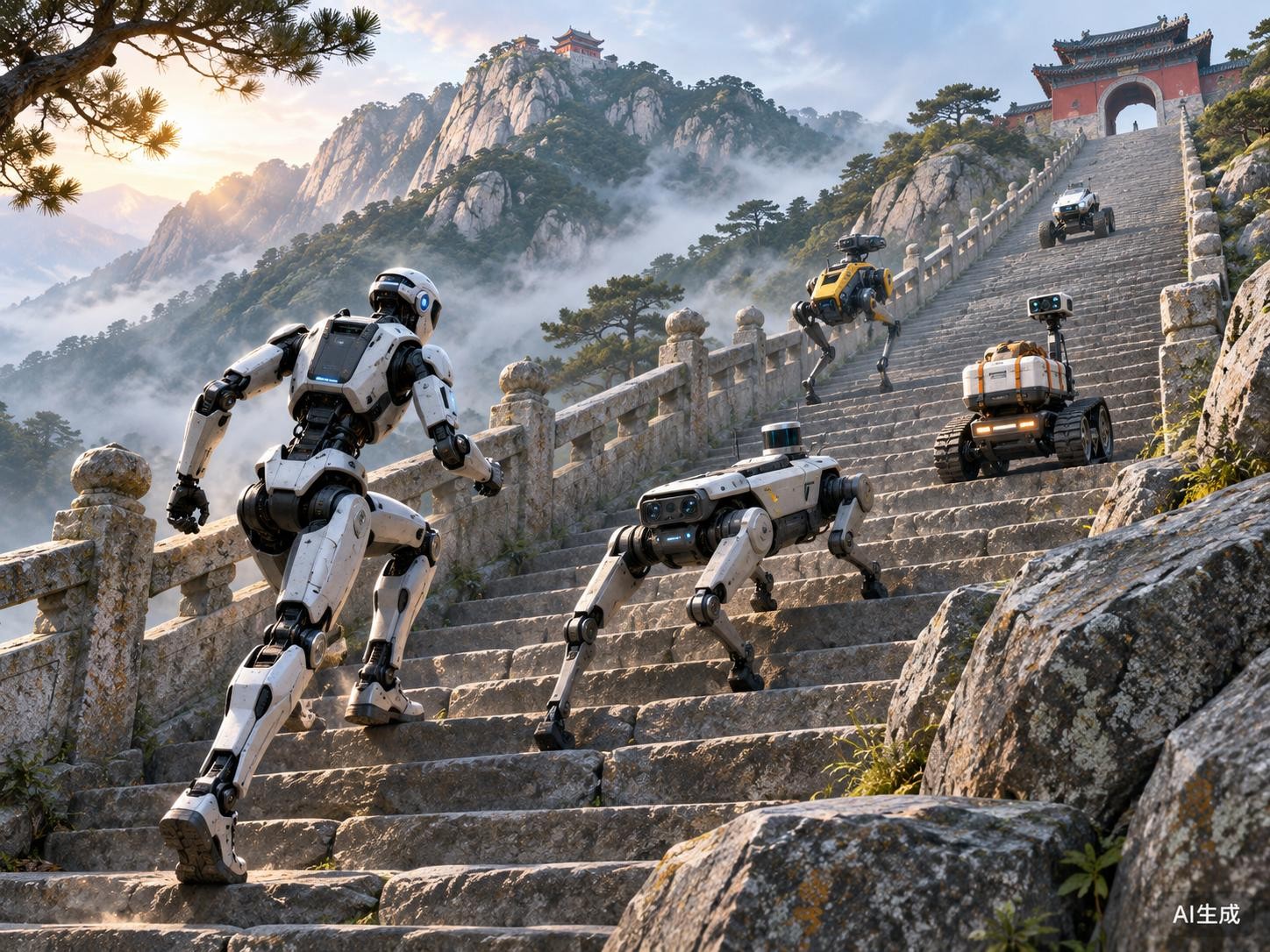
On November 2, the inaugural world robot mountain climbing championship officially kicked off on Mount Taishan in China's Shandong province. The organizers set up challenging courses in rugged mountain environments, dividing the competition into high-speed races and specialized trials. A wide variety of machines, including humanoid and quadrupedal robots, are participating in the event.
- The program features 4 main disciplines and 1 additional challenge.
- Humanoid robots tackle a 1.6 km route with over 600 steps.
- Quadrupedal robots face a grueling 3.9 km path with over 3,100 steps and a 600-meter elevation gain.
- Special events include payload carrying and exoskeleton testing.
Route specifications and terrain difficulty
For humanoid robots, the route spans approximately 1.6 kilometers from the Hongmen Square to the Doumu Temple, requiring them to climb more than 600 steps. Once the primary distance is completed, teams have the opportunity to test their machines on an additional, highly demanding segment of the trail. These trials help engineers evaluate the balance and stability of bipedal systems.
Quadrupedal robots face a far more severe test on the path to the Zhongtianmen station. The 3.9-kilometer route includes over 3,100 steps and an elevation gain of approximately 600 meters. The most treacherous part of the climb is recognized as the 'Twelve Bends' section, which features a vertical elevation gain of 92 meters.
Read alsoNeura Robotics and TUM launch 17 million euro RoboGym center for robotsSpecial challenges and navigation technologies
The specialized program includes load-carrying competitions for quadrupedal robots, mimicking the traditional porters of Mount Taishan, alongside tests for exoskeletons designed to ease movement on slopes. A separate challenge features wheeled, tracked, and spherical robotic systems. Navigating such terrain requires advanced technology.
To successfully navigate the mountain, the robots utilize lidars and cameras to build 3D maps of the environment in real time, accurately detecting steps and obstacles. During the ascent, internal control systems constantly analyze joint stress and body posture, dynamically adjusting stride length to maintain balance.
Significance of the competition for the robotics industry
Hosting such extreme competitions in real natural environments is vital for pushing the boundaries of modern robotics. The Mount Taishan trials allow engineers to stress-test hardware reliability, balancing algorithms, and computer vision systems under harsh conditions. The insights gained will pave the way for more resilient robots capable of performing rescue operations and industrial tasks in inaccessible areas.
Source: iXBT.com